
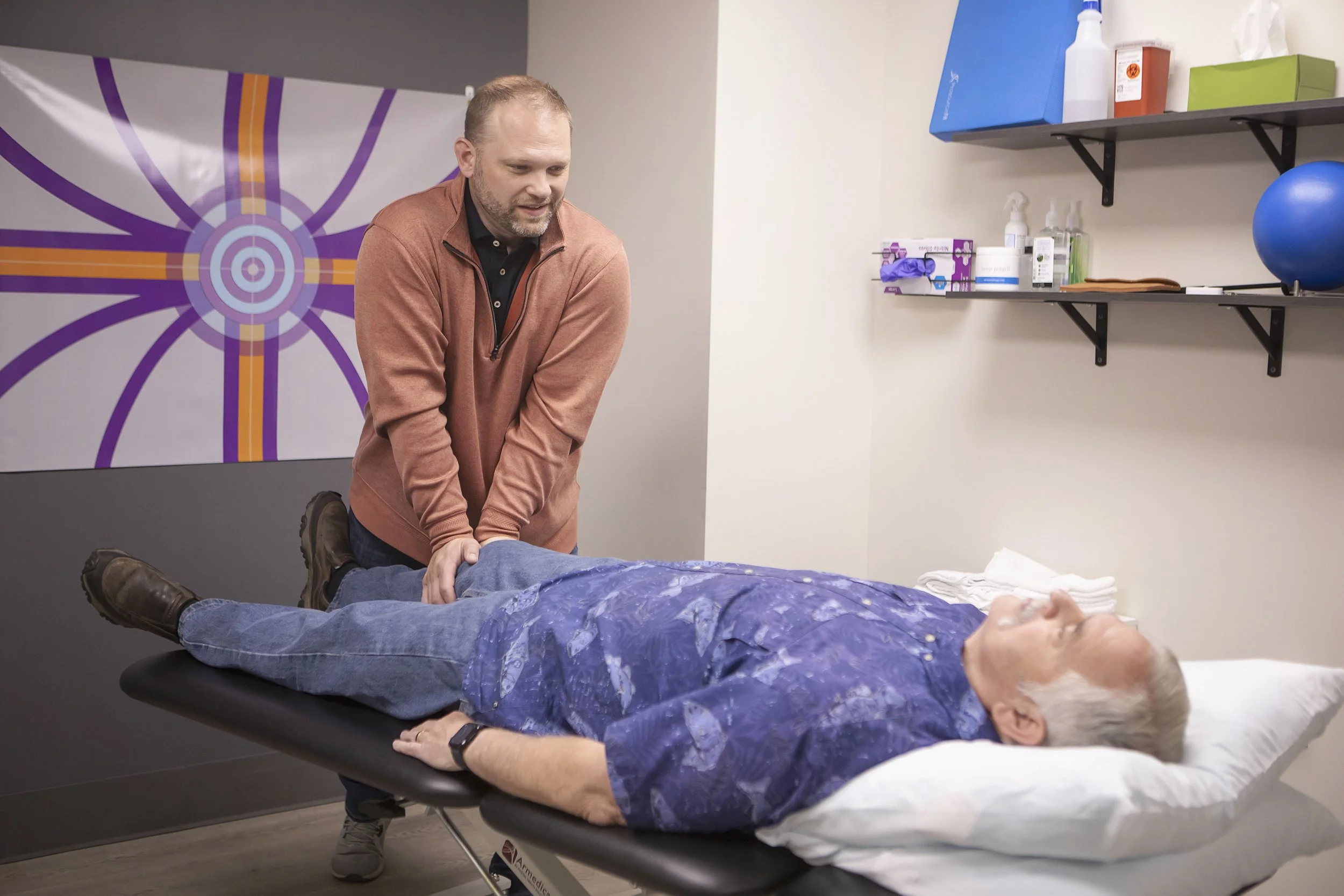
Maybe you've been putting it off for years. You've limped through one more fishing season, sat out one more round of pickleball, and watched the grandkids from a lawn chair instead of the backyard. Now the surgery date is on the calendar — or it's already behind you — and you're wondering what comes next.
Here's the honest, encouraging truth: a joint replacement is a great tool, but the surgery is only half the story. The other half is rehab, and that's where you have a lot of control over how things turn out.
The surgery fixes the joint. Rehab rebuilds the system.
A total knee or hip replacement swaps out a worn joint surface for a smooth new one. What it doesn't do is instantly restore the strength, flexibility, balance, and confidence that faded during the years you were favoring that leg.
Your muscles have often been "turned down" for a long time. Your walking pattern has adapted. And your nervous system has spent months or years learning to protect that joint. Physical therapy is how we update all of that so your new joint can actually do its job.
"It hurts — did something go wrong?"
This is the number-one worry we hear, especially in the first few weeks. So let's talk about it plainly.
Pain after joint replacement is expected. Surgery is a big event for the tissues around the joint, and your nervous system responds the way it's designed to: by turning up the alarm. Swelling, warmth, stiffness, and soreness — especially after therapy or a busy day — are part of normal healing.
Pain science gives us a helpful way to think about it. Pain is your body's alarm system, not a damage meter. Right after surgery, that alarm is extra sensitive, so activities that are perfectly safe can still feel uncomfortable. Hurt does not equal harm. A sore knee after your exercises usually means you worked it, not that you hurt it.
Here's a fact that surprises many people: some folks still have pain months after surgery even though their follow-up X-ray looks perfect. The new joint is in exactly the right spot. That tells us pain isn't only about what shows up on an image — it's also about how sensitive the nervous system has become. The good news? Sensitivity can be calmed down with education, graded movement, and time. Research by pain scientists like Adriaan Louw has even looked at teaching patients about pain before knee replacement to help recovery go more smoothly.
What the first weeks usually look like
Every surgeon has a protocol, and your surgeon's instructions always come first. In general, though, early rehab focuses on:
Getting the joint moving. For knees especially, regaining the ability to fully straighten and bend the knee early on is a big deal. Range of motion tends to get harder to gain the longer you wait.
Waking up the muscles. Quads, glutes, and hip muscles need to be retrained to fire and support you.
Managing swelling. Ice, elevation, gentle movement, and pacing your activity all help.
Walking well. We'll work on getting you from walker to cane to no device, with a smooth, even stride — not a habit limp.
Safe daily life. Stairs, getting in and out of the car (or the truck), the bathtub, and the recliner.
Later, rehab shifts to strength, balance, endurance, and the specific things you want back — kneeling in the garden, walking 18 holes, climbing into a deer stand, or stepping down onto a wobbly dock section in the spring.
Don't skip "prehab"
If your surgery hasn't happened yet, this is your opportunity. Going in stronger generally means coming out stronger. A few weeks of prehab before surgery can help you:
Build leg strength so early rehab feels more manageable
Practice your exercises while you're not sore, so they're familiar afterward
Learn how pain works post-op, so the normal soreness feels less scary
Set up your home (rugs, railings, a good chair) before you need it
How Alex PT helps
Every visit at Alex PT is one-on-one with a physical therapist — no bouncing between patients, no handing you off to an aide. Whether you had surgery here in Alexandria, in St. Cloud, or down in the Cities, we'll follow your surgeon's protocol, keep them updated on your progress, and tailor the plan to your life here in the lakes area.
We'll measure your progress so you can actually see it (that bend-angle number creeping up is very motivating), adjust your home program as you improve, and help you push through plateaus without overdoing it. And yes — Stella and Margot are excellent cheerleaders on the tough days.
Do I need a referral?
Minnesota allows direct access to physical therapy, so you can start prehab without a referral. After surgery, your surgeon will typically send orders for PT, and you get to choose where you go — you're welcome to choose Alex PT. We now accept insurance plans, and post-operative rehab is commonly covered.
Your next chapter starts here
A new knee or hip can open the door to years of more comfortable living — more pickleball, more golf, more time on the dock, and more floor time with the grandkids. Let's make sure you get every bit of that.
If you're in Alexandria or anywhere in the Douglas County lakes area and have a joint replacement coming up (or just behind you), we'd love to help — from the team voted Alexandria's "Best of the Best" two years running.
Alex PT — 591 Northside Dr. NE, Suite 200, Alexandria, MN 56308 Call (320) 445-0100 or book an appointment online.
Voted "Best of the Best" in Alexandria — and Stella and Margot approve this message.